
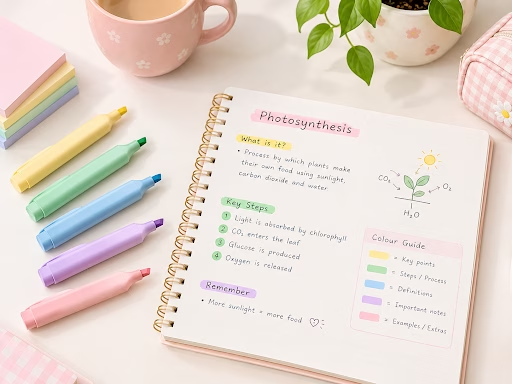
The simplest way to learn how to colour code notes is to give each highlighter one job and stick to it: one colour for key terms, one for definitions, one for examples, and one for things to memorise. Write this key on the first page of your notebook, use no more than four colours, and highlight only the most important 10 to 20 percent of each page.
That’s how to colour code notes in a nutshell. Everything below helps you set it up, choose the right version for your subjects, and keep it working all year.
Why Colour Coding Works
Colour coding turns a page of text into a map. When you revise, your eye jumps straight to the colour you need.
- Faster revision: scan only the blue lines when you need definitions
- Better memory: linking a colour to a type of information makes it easier to recall
- Cleaner pages: a clear system looks organised and intentional
- Less stress: you always know what to highlight and what to leave
The catch is consistency. A colour system only helps when every colour means the same thing on every page.
Cute stationery in a coordinated palette makes the whole system feel calm and easy to keep up.
The 4-Colour Highlighter Colour System

Here’s a simple highlighter colour system that works for most subjects:
| Colour | Job | Example |
| Pink | Key terms and headings | Photosynthesis, Mughal Empire |
| Blue | Definitions | “Osmosis is the movement of water…” |
| Yellow | Examples, dates, and names | 1857, Newton’s apple |
| Green | Must-memorise facts and formulas | E = mc², a² + b² = c² |
Pastel versions of these four shades keep pages soft and readable. Bright neon works too, but it can feel loud across a full notebook.
If you’re still choosing shades, these picks for highlighters for notes cover which ones look good together and stay smudge-free.
How to Colour Code Notes in 5 Steps

Here’s how to colour code notes from your first page.
- Pick your colours. Choose three or four highlighters that look clearly different from each other.
- Give each colour one job. Use the table above or create your own categories.
- Write a colour key. Put it on the inside cover or first page so you can glance at it anytime.
- Read first, highlight second. Finish a paragraph before highlighting so you mark only what truly matters.
- Review weekly. Flip through your notes and check that colours still match their jobs.
Write your notes in black or dark grey ink, then highlight. Dark text under a light highlight stays readable for years. These good handwriting pens write smoothly and pair well with highlighters.
3 Colour Coding Systems to Choose From
Different students need different systems. Pick the one that matches how you study.
System 1: By Type of Information
The 4-colour system above. Best for theory-heavy subjects like biology, history, and economics.
System 2: By Subject
Each subject gets its own colour across notebooks, tabs, and folders.
- Maths in blue
- Science in green
- English in pink
- Social studies in yellow
This works well for organising your bag and desk, and pairs nicely with System 1 inside each notebook. Matching an aesthetic document file to each subject colour keeps handouts and worksheets sorted too.
System 3: By Confidence (Traffic Light)
Perfect for revision before exams.
- Green: I know this well
- Yellow: I need one more review
- Pink: I find this tricky and need extra practice
On your final revision days, read only the pink and yellow parts. A set of gradient sticky notes makes great colour-matched tabs for flagging tricky pages.
| System | Best For | When to Use It |
| By information type | Theory subjects | While making notes |
| By subject | Staying organised | All year |
| By confidence | Exam revision | In the last few weeks |
Colour Coding Notes With Highlighters: Do’s for Clean Pages

Colour coding notes with highlighters works best with a few simple habits:
- Highlight keywords and short phrases: a few words per line are enough
- Keep one colour per idea: layering two highlights on one word muddies both
- Leave gaps between highlights: a few unmarked lines keep the page calm
- Test new highlighters first: try them on the last page to check for bleed
Pastel cute Highlighters suit these habits beautifully, since soft shades let your black text stay easy to read.
Done well, colour coding notes with highlighters makes a chapter look like a neat summary of itself.
Study Colour Coding Beyond Highlighters
Study colour coding gets even more powerful when the same colours show up everywhere.
- Pens: use a coloured pen for headings in the same shade as your key-term highlighter
- Sticky tabs: colour-matched tabs on the page edge mark chapters or tricky topics
- Folders: one coloured file per subject keeps loose sheets sorted
- Planner: colour exam dates and assignments by subject
For headings in matching shades, an aesthetic colour gel pen set lets you write titles in the same colours as your highlighters, so your study colour coding stays consistent on every page.
Colour Coding by Subject: Quick Examples
Here’s how to colour code notes for a few common subjects using the same four colours:
| Subject | Pink | Blue | Yellow | Green |
| Biology | Organ and process names | Definitions | Examples from daily life | Diagram labels to memorise |
| History | Events and rulers | Causes and effects | Dates and places | Key outcomes |
| Maths | Topic names | Rules and theorems | Worked examples | Formulas |
| English | Characters and themes | Literary devices | Quotes | Points for answers |
Keep the colour jobs the same and only change what fills them. A steady highlighter colour system across subjects keeps every notebook easy to read at a glance.
Quick Tips
- Swatch your highlighters: draw a small stripe of each colour next to its job on your key page.
- Buy duplicates of your main colour: your most-used highlighter runs out first, usually mid-exam season.
- Use a pencil for unsure points: underline lightly in pencil, then highlight once you’ve confirmed it matters.
- Colour the margin: a small highlighted dot in the margin flags a line without covering the text.
- Photograph your key: keep a photo on your phone so you remember how to colour code notes the same way across every notebook.
- Refresh each term: check whether your colour jobs still fit your subjects and tweak if needed.
Frequently Asked Questions
How many colours should I use to colour code notes?
Three or four colours is the sweet spot. Fewer colours keep the system easy to follow, and more than five usually makes pages look busy.
What is the best highlighter colour for studying?
Yellow is the most readable over black ink, which makes it great for the information you highlight most often. Pink, blue, and green work well as supporting colours.
Should I colour code notes while taking them in class?
It’s easier to write first and colour code later. Knowing how to colour code notes during revision also helps you review the material a second time.
How do I stop highlighters from bleeding through paper?
Use thicker paper, highlight with a light touch, and let the ink dry before closing the notebook. Kawaii Highlighters with soft chisel tips are gentle on thin pages.
What supplies do I need to start colour coding?
Three or four highlighters, a black pen, and a notebook are enough. A ready Stationery Kit for students often includes everything you need while learning how to colour code notes.
Shop the kawaii collection
-
Sale!
-
Sale!
 Select options This product has multiple variants. The options may be chosen on the product page
-
Sold Out
 Select options This product has multiple variants. The options may be chosen on the product page
-
Sold Out
 Select options This product has multiple variants. The options may be chosen on the product page

Explore More Blogs