
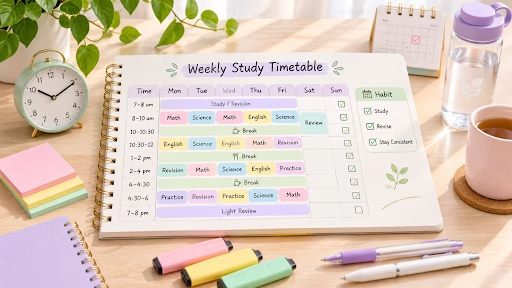
The best study timetable ideas are simple and realistic: plan 2 to 4 focused sessions a day, put your hardest subject in your highest-energy hours, add short breaks, and keep one flexible catch-up slot every week so one busy day leaves the rest of your plan intact.
A timetable works when it fits your real life, including school or college hours, tuition, meals, and a little scrolling time. The goal is a plan you can follow on an ordinary Tuesday, with room to breathe.
This post walks you through how to make a study timetable step by step, shares timetable styles for different routines, and gives you ready templates for a daily plan, a full week, and exam season. Every table is easy to copy into Google Docs, Notion, or your notebook, so you can start planning today.
What Makes a Study Timetable Easy to Stick To?
Good study timetable ideas have a few things in common:
- Realistic hours: 2 to 3 hours on school days and 4 to 6 on weekends suits most students
- Short sessions: 25 to 50 minutes of focus followed by a 5 to 10 minute break
- Energy matching: tough subjects go in your sharpest hours, light revision in tired hours
- Buffer time: one or two empty slots a week to catch up
- Visible plan: a timetable on your wall or desk gets used far more than one hidden in an app
Cute stationery makes the planning part fun, and a timetable that looks good on your desk is one you’ll want to open every day.
How to Make a Study Timetable in 7 Simple Steps
 Here’s how to make a study timetable that matches your day instead of fighting it:
- List your fixed hours. Write down school or college timings, tuition, travel, meals, and sleep.
- Find your free blocks. Whatever time is left is your real study time. Most students find 2 to 4 hours on weekdays.
- List every subject and topic. Break each subject into chapters so you know exactly what to cover.
- Rank subjects by difficulty. Mark each one as hard, medium, or easy.
- Match subjects to energy. Put hard subjects when you feel fresh, like early morning or right after a snack.
- Add breaks and buffers. Every session gets a short break, and each week gets a catch-up slot.
- Test it for one week. Adjust timings on Sunday based on what worked.
Tick off each finished session with a pen or sticker. Small wins keep the habit going.
If you’re building a study kit from scratch, this list of kawaii stationery covers the pieces students reach for most.
Which Study Timetable Ideas Work Best for Your Routine?
Different study timetable ideas suit different personalities. Pick the one that sounds most like you:
| Timetable Style | How It Works | Best For |
| Time blocking | Each subject gets a fixed block, like 5 to 6 pm for Maths | Students who like structure |
| Pomodoro sessions | 25 minutes of study, 5 minutes of break, repeated 4 times | Anyone who loses focus easily |
| Two subjects a day | Only two subjects daily, rotating through the week | Students who feel overwhelmed |
| Early bird plan | Hard subjects from 5:30 to 7 am, revision at night | Morning people |
| Night owl plan | Light revision after school, deep study from 8 to 10 pm | Late-energy students |
| Exam countdown | Work backwards from the exam date, chapter by chapter | Board and entrance exam prep |
You can also mix two styles, like time blocking on weekdays and Pomodoro sessions on weekends.
A Kawaii daily planner on your desk is an easy way to write the day’s blocks each morning, so the plan stays fresh and specific.
What Does a Daily Study Timetable Look Like?
Here’s a sample daily timetable for a school student with classes until 3 pm:
| Time | Activity |
| 6:30 am to 7:00 am | Quick revision of yesterday’s topic |
| 7:00 am to 3:00 pm | School |
| 3:00 pm to 4:30 pm | Lunch, rest, free time |
| 4:30 pm to 5:20 pm | Session 1: hardest subject |
| 5:20 pm to 5:30 pm | Break |
| 5:30 pm to 6:20 pm | Session 2: second subject |
| 6:20 pm to 7:30 pm | Play, walk, or hobby time |
| 7:30 pm to 8:15 pm | Session 3: homework and practice questions |
| 8:15 pm to 9:00 pm | Dinner and family time |
| 9:00 pm to 9:30 pm | Light revision and plan tomorrow |
| 10:00 pm | Sleep |
For a college student, swap the morning slot for a late-evening session and keep the same rhythm of focus, break, and review.
Colourful flags help here too. A Memo Sticker Roll is handy for jotting each session’s topic and sticking it right onto your timetable.
How Do You Plan a Weekly Study Plan?
 A weekly study plan gives every subject fair time and keeps Sunday light. Here’s a sample for a Class 10 student:
| Day | Session 1 | Session 2 | Session 3 |
| Monday | Maths | Science | English revision |
| Tuesday | Social Science | Maths | Hindi |
| Wednesday | Science | English | Maths practice |
| Thursday | Maths | Social Science | Science revision |
| Friday | Science | Hindi | Weekly doubts list |
| Saturday | Mock test | Test review | Weak topics |
| Sunday | Catch-up slot | Plan next week | Free time |
A few things make this weekly study plan work:
- Maths appears four times because it needs daily practice
- Saturday tests what you learnt during the week
- Sunday catches up on missed sessions and sets up the next week
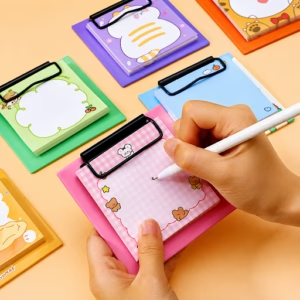
Writing your doubts on bright notes keeps them visible until you solve them. These ideas on how to use sticky notes while studying work beautifully alongside a weekly plan.
Free Study Planner Template You Can Copy
Use this blank study planner template for any week. Copy it into your notebook, a doc, or a sheet and fill in your subjects:
| Day | Time Slot | Subject | Topic or Chapter | Done |
| Monday | ||||
| Tuesday | ||||
| Wednesday | ||||
| Thursday | ||||
| Friday | ||||
| Saturday | ||||
| Sunday |
Tips for filling in this study planner template:
- Write specific topics, like “Chapter 3: Light, numericals” instead of just “Science”
- Keep the Done column for ticks or stickers
- Use one colour per subject so your week is easy to read at a glance
How Should You Change Your Timetable Before Exams?
Exam season calls for study timetable ideas that are tighter and more focused. Work backwards from your first exam date:
| Weeks Before Exam | Focus | Daily Study Time |
| 8 to 6 weeks | Finish the syllabus | 3 to 4 hours |
| 6 to 4 weeks | First full revision | 4 to 5 hours |
| 4 to 2 weeks | Sample papers and past papers | 5 to 6 hours |
| Final 2 weeks | Weak topics and quick notes | 5 to 6 hours |
| Day before | Light revision and rest | 2 to 3 hours |
Keep sleep at 7 to 8 hours even in the last weeks. A rested brain remembers much more.
What Stationery Helps You Stick to Your Timetable?
 The right supplies make any of these study timetable ideas easy to see and fun to follow:
- A daily planner or notepad for writing each day’s blocks
- Colour-coded pens or highlighters for each subject
- Sticky flags for doubts and topics to revise
- A habit tracker for streaks
- A neat desk so you sit down and start quickly
A Habit Tracker board turns your study sessions into a streak, and watching that streak grow is surprisingly motivating.
A tidy desk helps you start on time. A cute desk organizer keeps your timetable, pens, and notes within reach, so there’s zero setup time before each session.
Quick Tips
- Start small: begin with two sessions a day for the first week, then add a third once it feels easy.
- Use the 2-minute start: tell yourself you’ll study for just 2 minutes; most days you’ll keep going.
- Park your phone in another room: a clear desk keeps your focus sharp for the whole session.
- Pair study with a cue: the same playlist, mug, or desk lamp every session tells your brain it’s study time.
- Review on Sundays: spend 10 minutes checking what worked and move unfinished topics to next week.
- Reward streaks: a 7-day streak earns a treat, like a new pen or an evening off.
Frequently Asked Questions
How many hours should a student study in a day?
Most school students do well with 2 to 3 focused hours on school days and 4 to 6 hours on weekends. During exam season, 5 to 6 hours with regular breaks is a healthy upper range for most students.
What are some easy study timetable ideas for beginners?
Start with the two-subjects-a-day method or simple Pomodoro sessions of 25 minutes with 5-minute breaks. These study timetable ideas are light enough to follow from day one and easy to expand later.
Is it better to study in the morning or at night?
Both work well, so pick the time when you feel most alert. Morning people can keep hard subjects early, while night owls can save deep study for 8 to 10 pm and use mornings for quick revision.
How do I make my timetable look aesthetic?
Use one pastel colour per subject, add stickers for finished sessions, and keep your plan on a planner page or desk board. A cute layout from Kawaii Planners makes it something you enjoy opening every day.
What should I do if I miss a study session?
Move it to your weekly catch-up slot instead of squeezing it into the next day. Keeping one or two buffer slots each week keeps the rest of your plan on track.
Shop the kawaii collection
-
Sale!
-
Sale!
 Select options This product has multiple variants. The options may be chosen on the product page
-
Sold Out
 Select options This product has multiple variants. The options may be chosen on the product page
-
Sold Out
 Select options This product has multiple variants. The options may be chosen on the product page

Explore More Blogs